Executive Authority, Expanded: Tracing the Boundaries of gubernatorial Power in Tallahassee
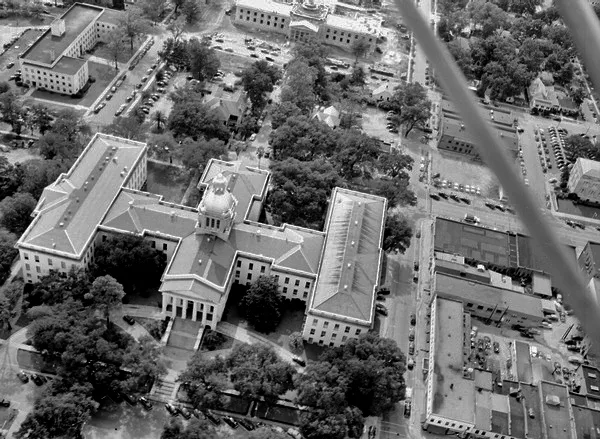
Photo: Forrest Granger, CC, via Wikimedia Commons
When Ron DeSantis took the oath of office in January 2019, few observers predicted that the former congressman would become one of the most consequential — and most scrutinized — executives in modern Florida history. Yet within two years, the governor's handling of the COVID-19 public health emergency had transformed the statehouse into a laboratory of aggressive unilateral governance.
This report reviews the principal instruments of that power: emergency orders, legislative special sessions, and structural reorganization of state agencies. The goal is not to pass judgment but to document, with the record as our guide, how the office of governor has been wielded in Tallahassee.
Emergency Powers in Practice
Florida's State of Emergency statutes grant the governor broad authority during declared disasters. DeSantis used that framework extensively beginning in March 2020, but he did so in a direction that diverged from most governors at the time: limiting local mask mandates, barring enforcement of business closures, and later prohibiting vaccine passport requirements by executive order before the legislature codified the ban.
Legal scholars noted that the governor's approach inverted the usual critique of emergency powers. Rather than expanding state coercion, the orders restrained local governments — raising a separate question about state preemption of municipal authority. Cities including Miami-Dade and Orange County found their public health measures overridden, prompting litigation that largely favored the state.
The Special Session Strategy
Perhaps no tool illustrates the modern playbook better than the special session. In November 2021, DeSantis called legislators back to Tallahassee to pass his proposal shielding workers from private employer vaccine mandates — a measure the regular session had not taken up on his timeline. Lawmakers complied in a matter of days.
In 2022, a second special session addressed property insurance, an issue that had simmered through multiple hurricane seasons. Critics observed that both sessions were convened to advance the governor's agenda rather than the legislature's, a reversal of the traditional dynamic in which legislative leadership drives the calendar.
Restructuring the Bureaucracy
Beyond legislation, the administration pursued structural change. The 2023 dissolution of the Reedy Creek Improvement District — the special taxing authority governing Walt Disney World — followed the company's public opposition to the Parental Rights in Education legislation. Though initially framed as retaliation, the eventual replacement district preserved most of the district's functions while placing its board under gubernatorial influence.
Other agencies saw leadership turnover and mission redirection, most notably at the departments handling health and education, where messaging priorities shifted markedly from the Scott and Bush eras.
How Does This Compare to Past Governors?
Every Florida chief executive has tested the constitution's limits. Reubin Askew used executive authority to push ethics reform in the 1970s. Jeb Bush reorganized government extensively and exercised sweeping appointment power. Rick Scott governed through a business-style command structure.
What distinguishes the current era is the speed and public orientation of these exercises of power. Where earlier governors negotiated quietly with legislative leadership, the present administration frequently stakes out positions publicly first, daring the legislature to follow. Political scientists describe this as a plebiscitary style — governing by permanent campaign — and it has proven effective at converting executive action into national attention.
What It Signals Going Forward
The Florida model is now studied in other state capitols, and candidates for governor elsewhere have campaigned explicitly on replicating it. Whether future legislatures reassert their institutional prerogatives, or whether the pattern becomes the new normal for executives of both parties, remains an open question.
What is not open to dispute is the record itself: emergency orders, special sessions, and agency restructurings have all been deployed more assertively in Tallahassee than at any point in recent memory. Documenting that record — provision by provision, order by order — is the work this publication will continue.